
PYLON is a low-SWaP body-worn node that aggregates body-worn Bluetooth sensor data, processes and encrypts it at the edge, and bridges it to the tactical network over a low-probability-of-intercept LoRa mesh, delivering an individual position for every operator below the squad leader. One end-user device per squad renders the full picture in TAK.
PYLON is an underlay, not a replacement. It complements program-of-record radios and leader end-user devices, and every inter-node link is an open standard.
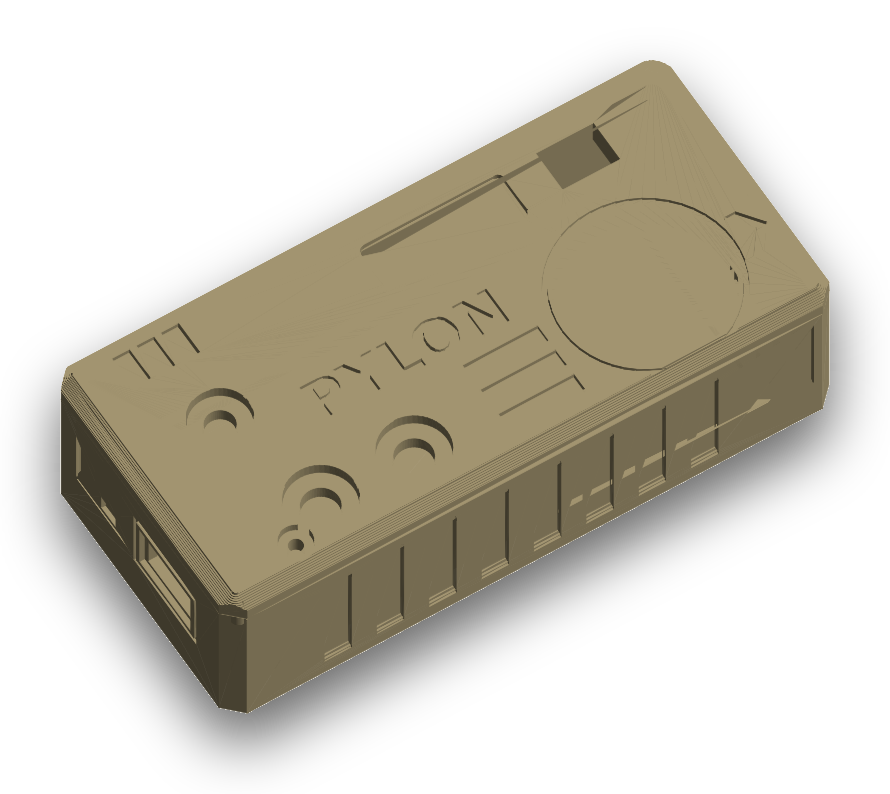
Engineering render of the Rev A enclosure.
Data arrives at the tactical network ready to transport, not as a raw dump. Everything downstream of PYLON is infrastructure the customer already owns.
Aggregates body-worn Bluetooth sensors, encrypts at the application layer, and formats output as Cursor-on-Target for native ATAK ingest. No gateway server, no custom integration.
On-device processing filters, prioritizes, and compresses raw sensor streams before the first network hop. The mesh carries events, not raw streams. Design target: at least 90 percent bandwidth reduction.
Multi-constellation GNSS with IMU dead reckoning from the last fix through GNSS denial. Enables fires deconfliction, casualty evacuation, fratricide prevention, and UAS deconfliction below the squad leader.
The left column is what exists on the bench today at Technology Readiness Level 4. The right column is the funded-effort target. We keep the two apart on purpose.
| Parameter | Current design (TRL 4) | Production target (funded effort) |
|---|---|---|
| Form factor | MOLLE-mountable body-worn node with sealed enclosure | Ruggedized overmold, same envelope |
| Weight | 94 g with battery (design weight) | 85 g |
| Environmental | Sealed enclosure selected for ingress protection | MIL-STD-810H subset qualified: drop, ingress, thermal |
| Power | Single-cell lithium-polymer battery, USB-C recharge; multi-day mesh-node design budget, under one watt peak | Validated 96 hours or more at full capability, 144 hours or more in cache-and-forward |
| Compute | Arm Cortex-M4F Bluetooth 5 SoC in a certified module with integrated PA/LNA | Same |
| Mesh radio | Sub-GHz LoRa transceiver, chirp spread spectrum, 902-928 MHz ISM band | Firmware-driven channel hopping across the configured sub-GHz plan |
| Transmit behavior | Short, infrequent bursts at a low duty cycle | Duty-cycled per emission-control mode |
| RF signature | Low transmit power and spread-spectrum modulation, designed to sit below narrowband detection thresholds | Detectability characterization in government experimentation |
| Onboard sensors | Six-axis IMU, multi-constellation GNSS, environmental (temperature, humidity, pressure) | Same |
| Sensor aggregation | Bluetooth 5 body-worn sensors: physiological, environmental, mission | Expanded peripheral profiles |
| Individual PLI | GNSS 1.5 m CEP nominal per chipset specification; IMU dead reckoning from the last fix through GNSS denial | Dead-reckoning performance validated under denial scenarios |
| Data output | Event-driven Cursor-on-Target on open standards; CivTAK native, ATAK-compatible; hands off to existing radios unchanged | TAK Server integration; bandwidth-reduction target instrumented |
| Security | Application-layer encryption | Frame authentication; cybersecurity documentation package |
| Emission control | Sealed, glove-operable hardware kill: RF power gate at the rail; no software or remote command can reactivate the radios | Four-mode selector: full operations, reduced signature, cache-and-forward, radio silent |
| Cost | All-COTS bill of materials; unit pricing on request | Held at production quantities |
Specifications describe the Rev A design under bring-up and are subject to change through qualification. Full data sheet available on request.
PYLON is designed from the ground up for contested electromagnetic environments. The LoRa link runs at a small fraction of a tactical radio's transmit power, in short bursts at a low duty cycle. Chirp spread spectrum pushes power spectral density below narrowband detection thresholds, and the self-healing mesh keeps each hop short. When the situation calls for silence, the operator gets it in hardware.
Bluetooth and LoRa mesh active. All sensors reporting. Training and permissive environments.
Bluetooth at minimum power. LoRa disabled at the hardware level, not in software. Contested environments.
Bluetooth receive only. LoRa off. Sensor data logged to non-volatile memory and burst-transmitted when the situation permits.
All radios off through a hardware kill switch that physically opens the RF path. Zero emissions. No software or remote command can reactivate.
As built today: sealed, glove-operable hardware kill at the rail. The four-mode selector is the funded design.
Tactical radios, soldier hubs, and end-user devices each do one job well and each stop at the leader. PYLON sits underneath all of them and extends the network to the soldiers who carry none of them. It hands existing radios pre-compressed Cursor-on-Target, it gives soldier hubs a peripheral their architecture already expects, and it gives the leader's end-user device a picture of the whole squad instead of a picture of the leader.
All development to date has been company-funded ahead of any government dollar, and all intellectual property is founder-developed and company-owned.
Law enforcement tactical teams in transit tunnels, wildland hand crews beyond repeater coverage, incident commanders at a mass-casualty scene, underground mine supervisors, and expedition crews far from any tower all need the same three things: where their people are, what condition they are in, and a way to stay connected without infrastructure. PYLON's hardware, firmware, and open output format are designed to serve each of them.